


Deep Endometriosis
24 year old patient, nullipara who desires to obtain pregnancy after the surgical treatment of endometriosus.
The patient preseent intense dyspareunia and dysmenorea (VAS=8) TV ultrasound reveals bilateral endometriotic cysts Surgery: Robotic cystectomy, excision of left parametrial deep endometriosis lesions Robotic cystectomy – the excision of the endometriotic cyst can be easily performed with the robot without affecting the ovarian structure.
Even in the adherent areas around the ovarian hilum dissection is easily done without stripping healthy ovarian tissue.
A difficult case recently successfully performed by Endomedicare Academy team: a young woman of age 27 with deep endometriosis infiltrating both parametrium, the rectum and the right ureter.
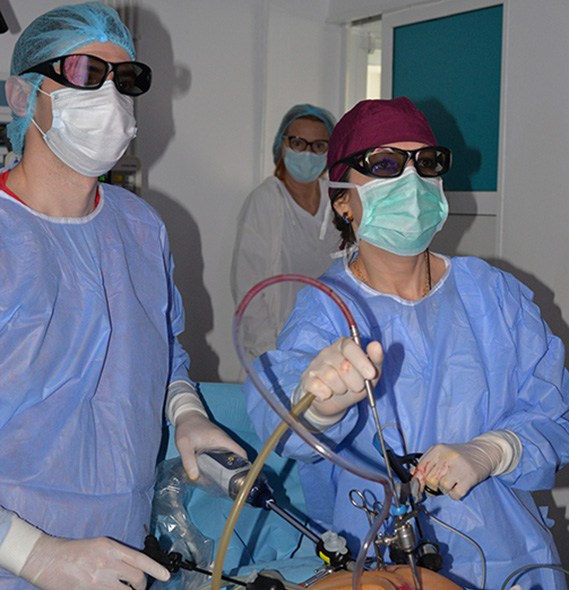
The case was surgically managed using the robotic DaVinci XI platform.
A complete preoperative imagistic diagnosis was necessary for assessing the need of a multidisciplinary team. Both transvaginal ultrasound and MRI showed bilateral ovarian endometriomas, parametrial left and right nodule, deep infiltrating endometriotic nodule of the rectum of around 2,5.
Kidney ultrasound showed hydronephrosis grade 3 on the right side. The robotic platform was used by mutidisciplinary surgical specialties including gynecology, colorectal, and urology to ensure complete resection of endometriosis lesions involving multiple organs.
The bilateral parametrial deep infiltrating endometriotic nodules excision, rectosigmoidianresection with end to end anastomosis and ureteral reimplantation were performed completely using da Vinci XI robot.
⇒ No ileostomy;
⇒ Fast recovery. After 4 days, our patient left the hospital in a very good shape.
Ask for information about the robotic intervention
Additional Services
Need a Second opinion?
We understand choosing a medical center for a surgery is a difficult decision, very different by choosing a holiday.
Patient Care Manager: May I guide you?
For the medical process and for the patient care services we recommend contacting our Patient Care Manager to advise you.
Travel Manager: May I guide you?
For the traveling process and for the travelling services we recommend contacting our Travel Manager to advise you.
Interventions
Endometriosis surgery
With a remarkable expertise of over 15 years in gynecological surgery, focusing on minimally invasive endometriosis surgery.
Our team, led by Prof. Dr. Elvira Bratila, has successfully performed over 450 interventions of complex forms of deep endometriosis – deep bladder, ureteral endometriosis, endometriosis with multiple intestinal locations -helping hundreds of patients regain their health and quality of life in a disease that invalidates the patients through pain, infertility and psychological impact.
