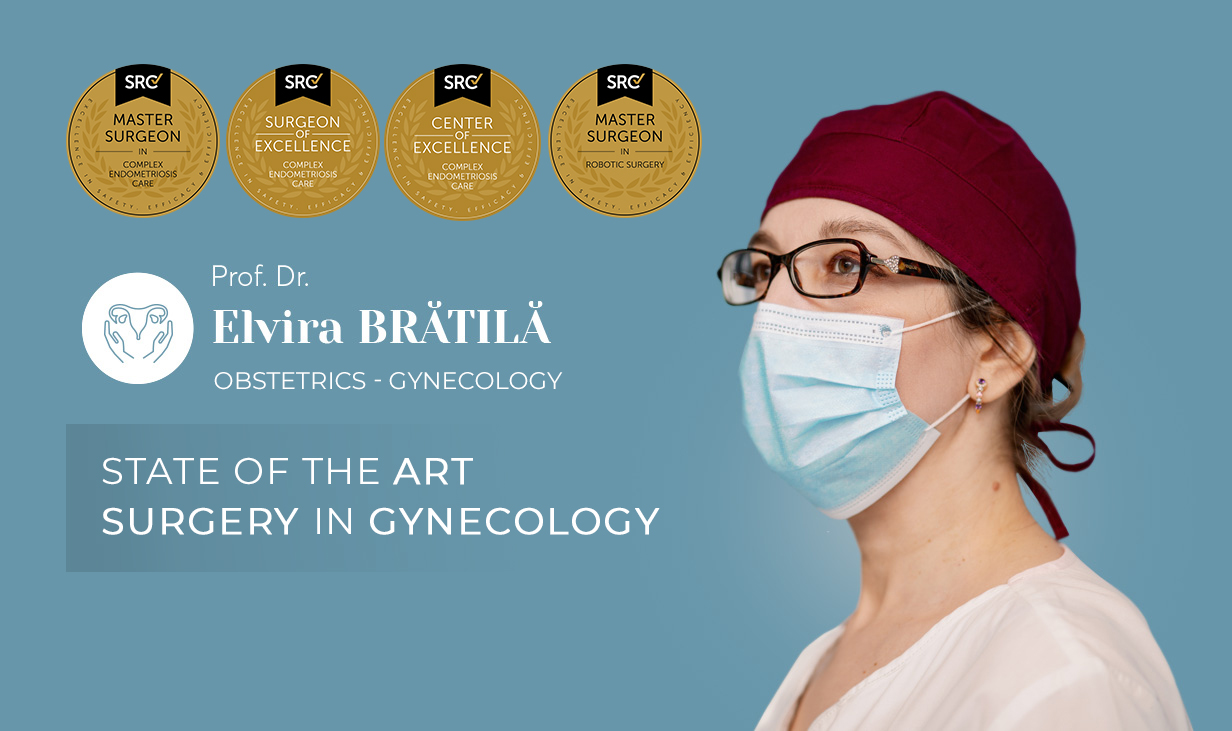
State of the art surgery in gynecology
“Pythagoras said that medicine is the most godlike of arts. The art of medicine involves passion for medicine, learned skills, cognitive understanding, emotional perception, professional intuition and wisdom in understanding that a patient is both body and soul.
Medical care is the ability to use evidence-based medicine to particularize it to get the best outcome for every patient as a unique human being, recognizing the importance of human understanding and an ethical commitment to care. “ Prof. Dr. Elvira Bratila

Endomedicare Academy Center is present in the following clinics:

Constanța

Spitalul din afară, lângă tine
București

Clinicã de îngrijire integratã a femeii – București

“Endomedicare Academy” – Center of Endometriosis

“Endomedicare Academy” Center of Endometriosis, Bucharest, Romania:
Is an integrated multidisciplinary team dedicated to the diagnosis, treatment and minimally invasive surgery of endometriosis. In numbers:
- Over 15 years in endometriosis surgery;
- Over 1000 interventions of complex forms of deep endometriosis;
- Over 99% of the minimally invasive endometriosis interventions performed;
- Ileostomy-less than 1%.
Interventions
With a remarkable expertise of over 15 years in gynecological surgery, focusing on minimally invasive endometriosis surgery.
Our team, led by Prof. Dr. Elvira Bratila, has successfully performed over 1000 interventions of complex forms of deep endometriosis – deep bladder, ureteral endometriosis, endometriosis with multiple intestinal locations -helping hundreds of patients regain their health and quality of life in a disease that invalidates the patients through pain, infertility and psychological impact.
Uterine fibroid is the most common benign tumor that develops in the muscular layer of the uterus. The onset and development of uterine fibroids occurs during a woman’s reproductive period, with significantly elevated hormone levels during this period contributing to their growth.
Approximately 40% of women over the age of 35 are diagnosed with uterine fibroids. In most cases there are several fibroid nodules in the uterus, ranging in size from a few millimetres to impressive dimensions when their increased number and size can reach the size of a full-term pregnancy.
Cervical cancer surgery starts under the auspices of two basic principles: preserving the fertility of women of reproductive age who wish to bear children in the future, and individualized treatment, depending on the stage of the disease, the extent of the cancer and ways of preventing recurrence.
Cervical cancer surgery is divided into two types: early cervical cancer surgery, we are talking about stage 1A and 1B1, i.e. tumors under 2 cm, and advanced cervical cancer surgery, tumors over 2 cm, with the potential to spread and evolve.
Endometrial cancer affects women during menopause with a peak incidence in women aged 55-60. An increase in incidence has recently been observed in the under 50s, mainly due to the increasing impact of obesity in younger women. Initially, surgery for the disease consisted of the classical approach, but with time treatment by minimally invasive surgery has shown its superiority and benefits for patients.
Because it frequently occurs in older patients who find it difficult to tolerate general anaesthesia, a “milder” solution was sought that would provide oncologic targeted treatment.
The hysterectomy is the surgical procedure that involves the removal of the uterus. The total hysterectomy implies the removal of the uterus, as well as the cervix, the component which stabilizes the uterus by its attachment to the pelvic ligaments and is connected distally to the vagina.
The decision involving the removal the ovaries and the fallopian tubes is taken with regard to their ultra-sonographic and intraoperative aspect, the age and the pathology of the patient.
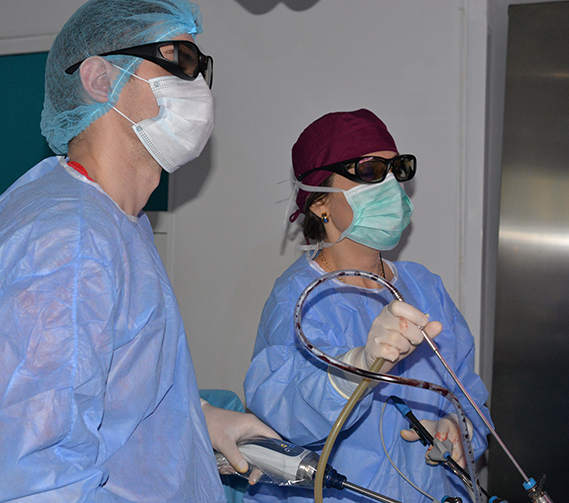
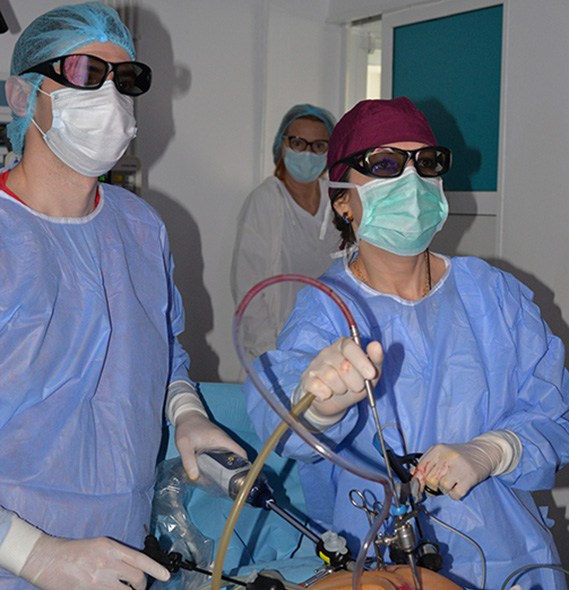
The procedure is done laparoscopically, under general anesthesia, by using four 5 mm incisions – one for the optical instrument and three for the surgical instruments. After identifying the urinary bladder and the ureters, the surgeon dissects the anatomical spaces surrounding the cervix, exposing the uterine arteries for visualization.
A polypropylene band is then placed around the uterine cervix, medially to the uterine vessels.

Additional Services
Need a Second opinion?
We understand choosing a medical center for a surgery is a difficult decision, very different by choosing a holiday.
Patient Care Manager: May I guide you?
For the medical process and for the patient care services we recommend contacting our Patient Care Manager to advise you.
Travel Manager: May I guide you?
For the traveling process and for the travelling services we recommend contacting our Travel Manager to advise you.
Need a second opinion?
Send an e-mail to Prof. Dr. Elvira Bratila & upload medical documents
Mentorship
Inspiris Mentorship Program
Elvira Bratila, MD, PhD: “Medicine is a continuous learning process. Therefore, my advice to the young specialists is to get continuously informed and educated, to be updated with the progress within the field in which one practices. Get involved in the field you are passionate about! It is very important in surgery that you do it with passion. This way you will not perceive it as an effort, but as a life goal. Last but not least, have courage to exceed your limits, dare following your dreams, believe in your strengths and share your passion with the world!”
The study of medicine is a process that requires a constant update of specialists, with a view to face the technological progress and to keep up with the innovation occurring in the entire medical spectrum of the our time.